

Sourdough Instructions
Contents
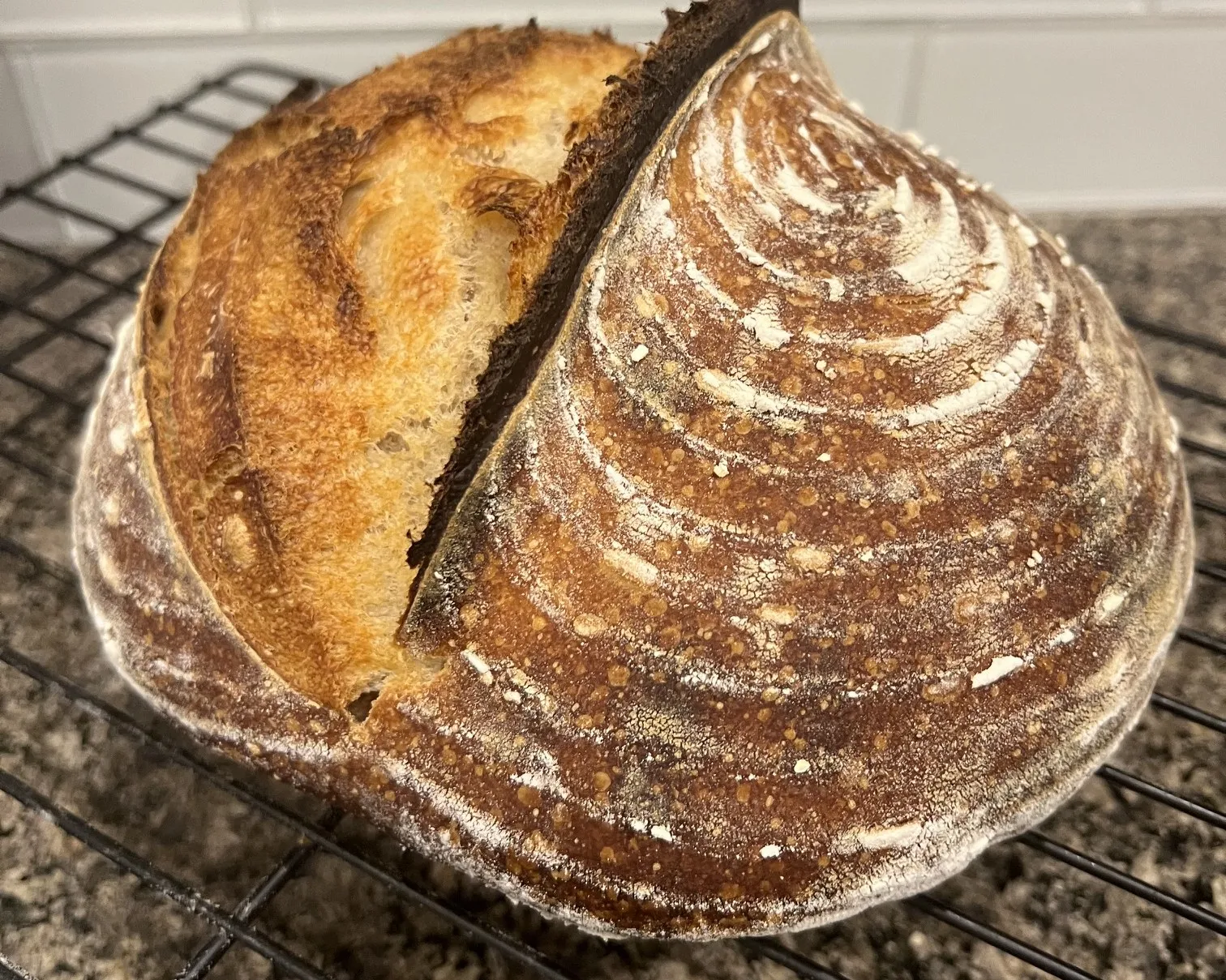
These are the notes I bake from. I tried recipes shared on Reddit and worked through my own experiments until I found a formula that worked for me. Later, I discovered that it was very close to Tartine’s country bread. I keep the instructions here in the step-by-step format I find easier to follow, along with what I’ve learned about maintaining a small starter and reading the dough.
I use a single-loaf batch when experimenting so a disappointing bake doesn’t waste as much flour. Treat the timings as guidelines: starter activity and room temperature determine the actual schedule.
Start here
This guide is for first-time sourdough bakers who want to work toward great-tasting, Instagram-worthy loaves. It walks through the steps I use and explains what to look for as you learn about dough strength, fermentation, shaping, and a more open crumb. Your first loaf doesn’t have to look perfect.
If the detail feels overwhelming, I recommend Ben Starr’s Simple Sourdough for Lazy People video. He demystifies the process and offers a lower-effort approach to making bread without all the fuss. His written recipe accompanies the video. Follow his complete method if you choose that route, rather than mixing its steps with this recipe.
This guide starts with an established, active sourdough starter. Creating a starter from scratch is a separate process.
A few terms before you begin
- Starter: The flour-and-water culture used to ferment the bread.
- Levain: A small build made from your starter for this batch. It is not a separate kind of yeast.
- Bulk fermentation: The first rise of the whole batch, before shaping. The resting and folding time is part of this stage.
- Proof: The final rise after shaping and before baking.
- Crumb: The inside texture of the baked loaf.
- Banneton: A basket that supports the dough during its final proof; it does not go in the oven.
Yield
This batch makes about 985 g of dough, the combined weight of the ingredients right after mixing: one large loaf, or two smaller loaves of about 492 g each. You’ll have slightly less to shape, because some dough stays in the bowl and on your hands, and a little moisture evaporates during fermentation and proofing. Choose a banneton and baking vessel that suit the dough portion. Baking reduces the weight further. The baking times below describe the original single-loaf method; smaller loaves may need a different bake time.
Ingredients
Levain build
- About 1/2 tablespoon active starter (approximately 5 g; the weight varies with aeration).
- 30 g white flour.
- 30 g whole-wheat flour.
- 60 g water.
The seed starter is an approximate volume measure: its aeration affects how much a spoonful weighs, so 5 g is a rough guide rather than an exact conversion. This build makes roughly 125 g levain, which is more than the dough needs. Use 100 g ripe levain in the dough; do not add the whole build. Readiness matters more than an exact 12-hour deadline.
Final dough
- 100 g ripe levain.
- 450 g white flour.
- 50 g whole-wheat flour.
- 375 g warm water, divided into 350 g for the initial mix and 25 g with the salt.
- 10 g salt.
For dusting
- Equal parts whole-wheat flour and rice flour, as needed.
Small starter maintenance
- 20 g water and 20 g flour per feeding, plus the starter retained in the container as described below.
Equipment
I mix by hand in a large metal bowl and weigh the ingredients with a digital scale. A stand mixer is optional; using my hand leaves one less thing to clean. I sometimes use a smaller bowl to weigh lighter ingredients such as salt, but that’s personal preference.
For the rest of this method, have a small starter container, a towel or cover, a banneton, a Dutch oven, a sharp scoring tool, oven mitts, and a cooling rack. The original instructions use a 10-inch banneton. A small straight-sided glass is optional for monitoring the dough’s rise.
Hydration
Assuming the ripe levain is 100% hydration (equal weights of flour and water), the dough is approximately 77.3% total hydration. The 100 g levain contributes about 50 g flour and 50 g water. With 500 g flour and 375 g water added to the dough, that is 425 g total water divided by 550 g total flour.
Before adding the salt and the final 25 g water, the initial mix is approximately 72.7% hydration. Adding the reserved water brings it to the final 77.3%. The unused levain is not included in either calculation.
This is a fairly wet dough, so some stickiness is expected. Hydration describes the water-to-flour ratio; it is not a score for how good the bread will be.
Starter Feeding
- Feed as early as when the starter has doubled. This will be 1 to 3 times per day when left on the counter. The frequency depends on the room temp and the type of flour.
- Store in the fridge when not baking. It can go a week or two without feeding in the fridge. After taking it out of the fridge, try to get at least 3 feedings in before making a levain. If you don’t, the starter will not be very active.
- If you are planning on making a levain in the next couple days, try not to let the starter starve. Once it collapses and runs out of food, a layer of liquid (hooch) will form on top. This is fine, but a starved starter turns acidic and sluggish, which slows the development of your levain and dough.
- I typically only maintain a 40 gram starter. This reduces my discard waste. In a small container I add about a teaspoon of starter, 20 grams of water, and 20 grams of flour. On the next feeding I use the same container and dump all of the starter leaving only what remains on the sides of the container. To this I add my water which I mix thoroughly until the starter is fully dissolved then add the flour until it is a consistent mixture with no lumps.
Making and baking the dough
- Mix about 1/2 tablespoon active starter (approximately 5 g; the weight varies with aeration), 30 g white flour, 30 g whole-wheat flour, and 60 g water to make levain.
- Rest about 12 hours, adjusting for starter activity and temperature. Use when the levain is aerated, has risen substantially, and has a rounded top. If it has collapsed, refresh it and allow it to become active again before using it.
- Mix 100g levain and 350g warm water
- Add 450g white flour, and 50g whole-wheat flour
- Rest 25 to 40 minutes
- Add 10g salt and 25g warm water
- Rest 30 minutes
- During bulk fermentation, perform six rounds of stretch and folds, about 30 minutes apart. The dough should gradually become stronger and hold its shape better; strength alone does not tell you that fermentation is complete.
- As a starting point, aim for a dough temperature of about 75–80°F (24–27°C) and roughly 3–4 hours of bulk fermentation from mixing the levain into the dough, including the rests and folding rounds. Look for a dough that is aerated and billowy, with about a 20–30% increase in volume, rather than waiting for it to double. If it has not reached that stage, allow more time. Cooler dough or a less active starter can take longer; warmer dough can move faster. Follow the dough rather than the clock.
- Shape into round
- Rest 30 minutes covered with towel
- Dust 10” banneton with 50/50 mix of whole-wheat and rice flour
- Final shape
- Rest 3 to 4 hours (10 to 12 in refrigerator)
- Preheat oven to 500°F (260°C) for 30 minutes
- Dust loaf bottom with 50/50 mix of whole-wheat and rice flour
- Score
- Place in Dutch oven
- Lower oven to 450°F (230°C) and bake for 20 minutes with lid on
- Bake at 450°F (230°C) for 20 minutes with lid off
- Place on cooling rack. The bread is still cooking even on the cooling rack. If you cut into it while it is still warm, it will have a gummy texture and dry out much quicker.
Example schedule: overnight levain, evening bake
This is an illustration, not a deadline. Move later steps when the levain or dough needs more time. Have an active starter ready before beginning.
| When | What to do |
|---|---|
| Previous evening, around 8 p.m. | Mix the levain. |
| Next morning, around 8 a.m., if ready | Check for ripe levain, then mix the dough. |
| After 25–40 minutes | Add the salt and remaining 25 g water. |
| After another 30 minutes | Begin six stretch-and-fold rounds, spaced 30 minutes apart. |
| Roughly 3–4 hours after mixing the levain into the dough, if ready | Look for an aerated, billowy dough and about 20–30% rise. Preshape, rest covered for 30 minutes, then final-shape and place in the banneton. Allow more time if needed. |
| After the final proof | Bake using the method’s temperatures and times. Allow roughly 3–4 hours for the room-temperature proof, or use the existing 10–12-hour refrigerator option and bake later. |
| After baking | Cool on a rack before cutting. |
Preheat during the end of the proof so the oven is ready when the dough is ready. An evening bake is only an example; a slower bulk fermentation may shift the bake later.
Learning from your first loaves
As you work toward the loaf you want, learn what ripe levain and fermented dough look and feel like, and let the finished loaf cool before judging the crumb. Note the dough temperature, approximate rise, timing, and what you liked about the bread.
If you want to work toward a more open crumb, pay attention to dough strength during folding, fermentation readiness, and gentle shaping. Change one thing at a time so you can tell what helped. The crumb-reading guide is useful when you’re ready to compare results; you don’t need to study it before your first loaf.
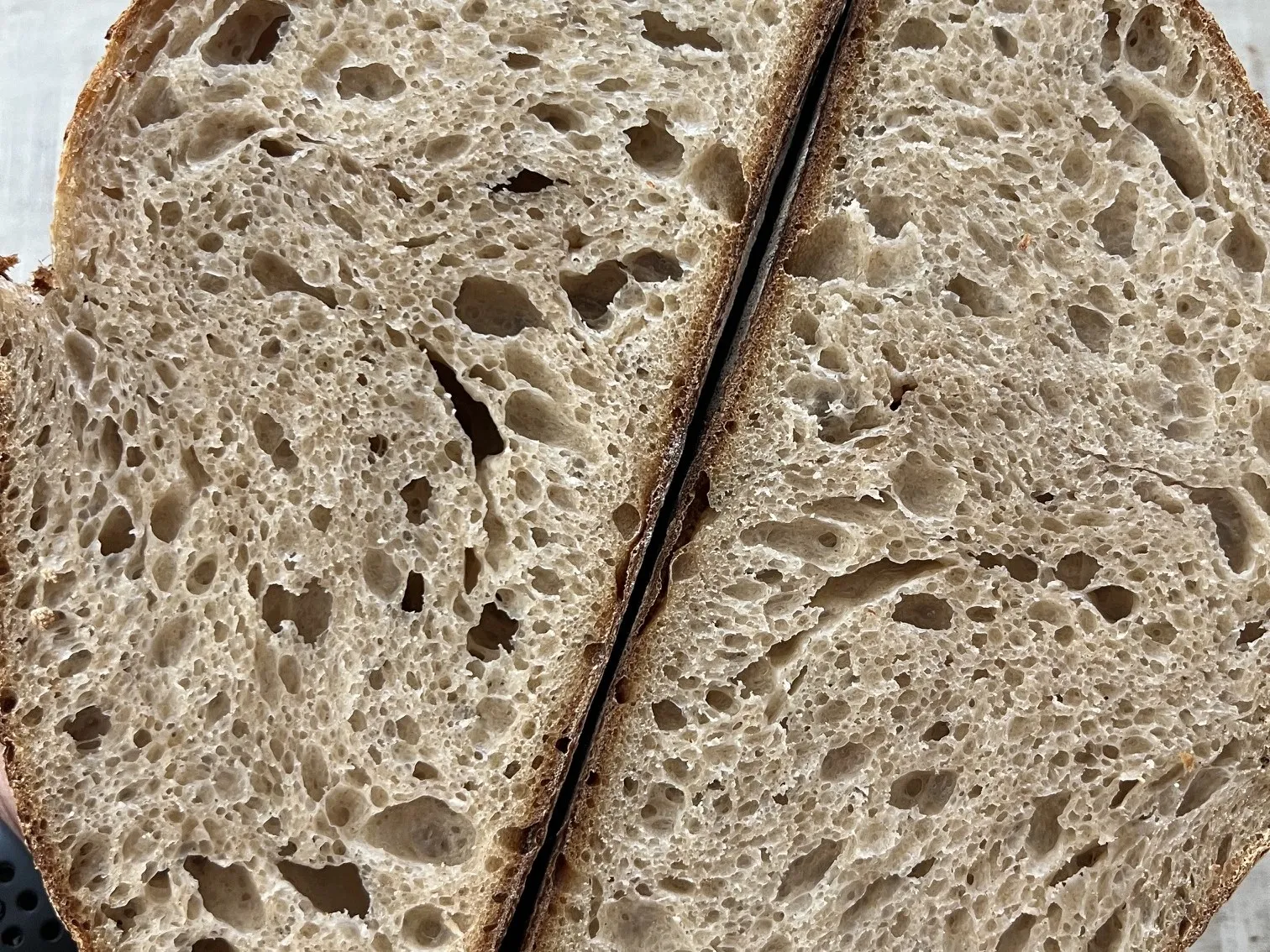
One of my loaves with an open, even crumb: the holes are spread through the whole loaf.
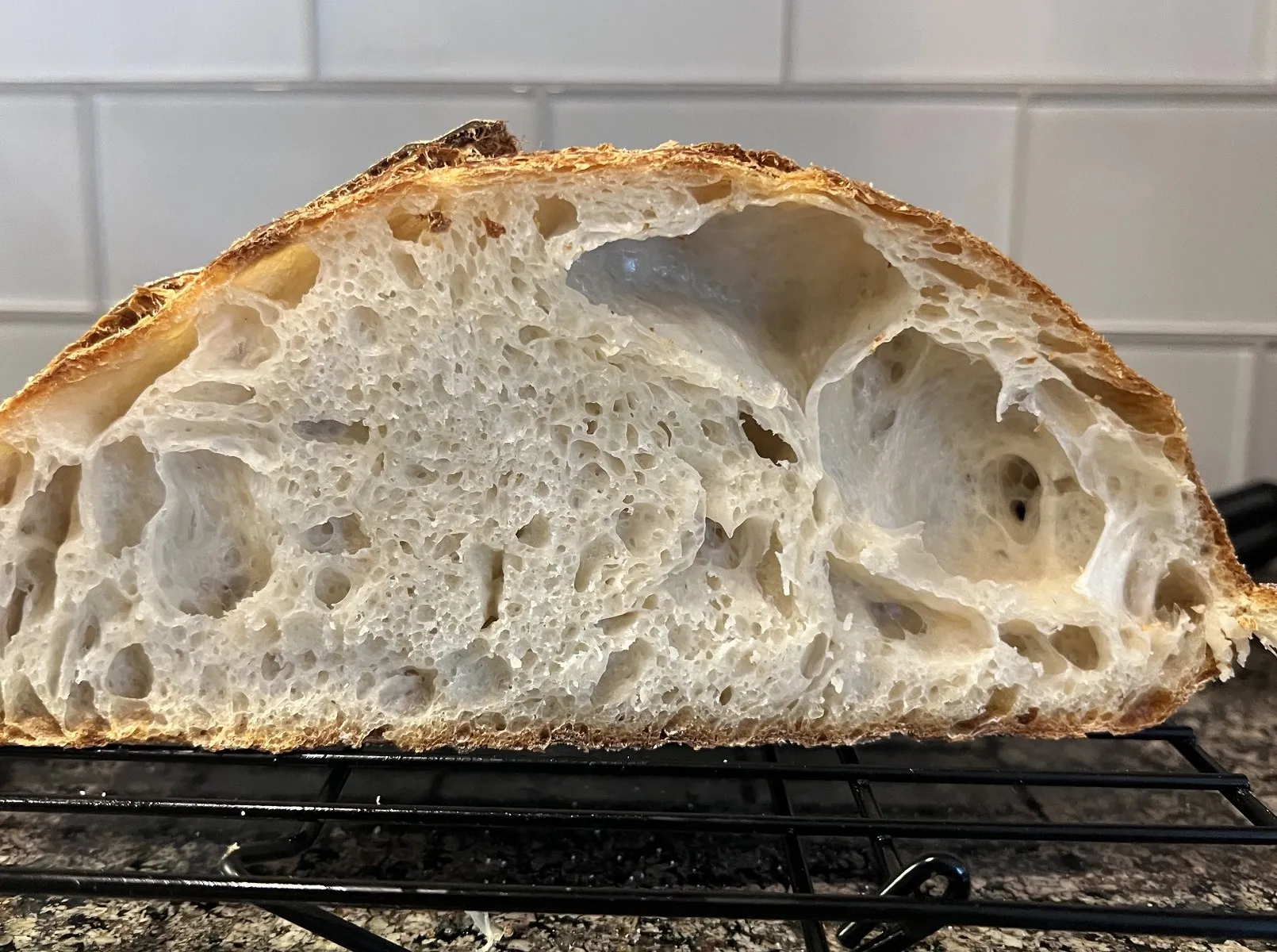
One of my less successful loaves: a large hollow under the top crust over a tighter crumb. A loaf like this is worth comparing against the crumb-reading guide.
Tips
- For starter, levain, and the dough, the timing is very subjective. How active the starter is and the temperature of the room will play a huge role in the time. It’s best to work based on the look and feel.
- Take a small piece of dough, put it in a shot glass, and cover it. Use this as a benchmark for how much your dough has risen. It is easier to mark the glass at the start to see how much it has risen than it is to guess by looking at a ball of dough in a bowl.
- Add a little salt to the sourdough starter discard and pan fry it to make a little biscuit. This goes well with eggs. This is the easiest way I’ve found to use the discard and prevent waste. Some people collect and save the discard to make other recipes which can be found online.
- Cut the loaf in half and take a photo of both cut faces for reference. Make note of anything unique and compare your crumb to The ULTIMATE Sourdough Proofing Guide PDF guide below.
- To cut into slices, first cut the loaf in half. Then place the cut side down on the cutting board. This will prevent the bread from crushing while cutting.
Next steps
If you have an active starter, gather the ingredients and equipment above and use the sample schedule to plan your first batch. Follow the dough’s readiness cues as you work, and jot down what you would change for your next loaf. If the detailed method feels overwhelming, start with Ben Starr’s simpler complete method instead.
References
- A Complete Glossary of Sourdough Terminology — A terminology reference covering concepts such as autolyze, bulk fermentation, crumb, hydration, levain, proofing, oven spring, and stretch-and-fold.
- Under-Proofed or Over-Proofed — The Sourdough Journey’s guide to recognizing under-, properly-, and over-proofed loaves, particularly from the baked loaf and crumb.
- Sourdough Hydration Calculator — Calculates dough hydration while accounting for flour and water contributed by the starter or levain; also includes tools for working with starters of different hydration levels.
- Tartine Country Bread — Tartine Bakery’s reference for its iconic country loaf and the process behind it.
- How to Make Basic Sourdough with Abby Love — Barton Springs Mill’s video walkthrough of a basic sourdough loaf.
- Simple Sourdough for Lazy People — Ben Starr’s simplified sourdough method, designed to reduce hands-on work and eliminate many of the more involved steps used in traditional workflows.
- The ULTIMATE Sourdough Proofing Guide — Part 1: How to Read a Sourdough Crumb — A visual guide for evaluating proofing from loaf height, crumb holes and distribution, oven spring, bloom, and crust color.
- The Importance of Dough Temperature in Baking — Explains desired and final dough temperature, how temperature affects fermentation, and how to calculate mixing-water temperature for better consistency.
Revisions
- October 4, 2026 — Added beginner orientation and a low-effort alternative, recipe background, consolidated ingredients and equipment, clarified yield, starter measurement and hydration, revised bulk-fermentation guidance, and added a sample schedule and print support. Added practical next steps for readers. Added photos of a finished loaf and two crumbs.
- October 3, 2026 — This article has been updated. Detailed revision notes will be recorded here from this point forward; earlier changes are not itemized.