

Be Prepared: A Disaster, Survival, and Camping Checklist
Contents
“Be Prepared” has stuck with me since my time in the Boy Scouts, where I earned Eagle Scout. It’s a useful starting point for thinking about everyday problems as well as emergencies.
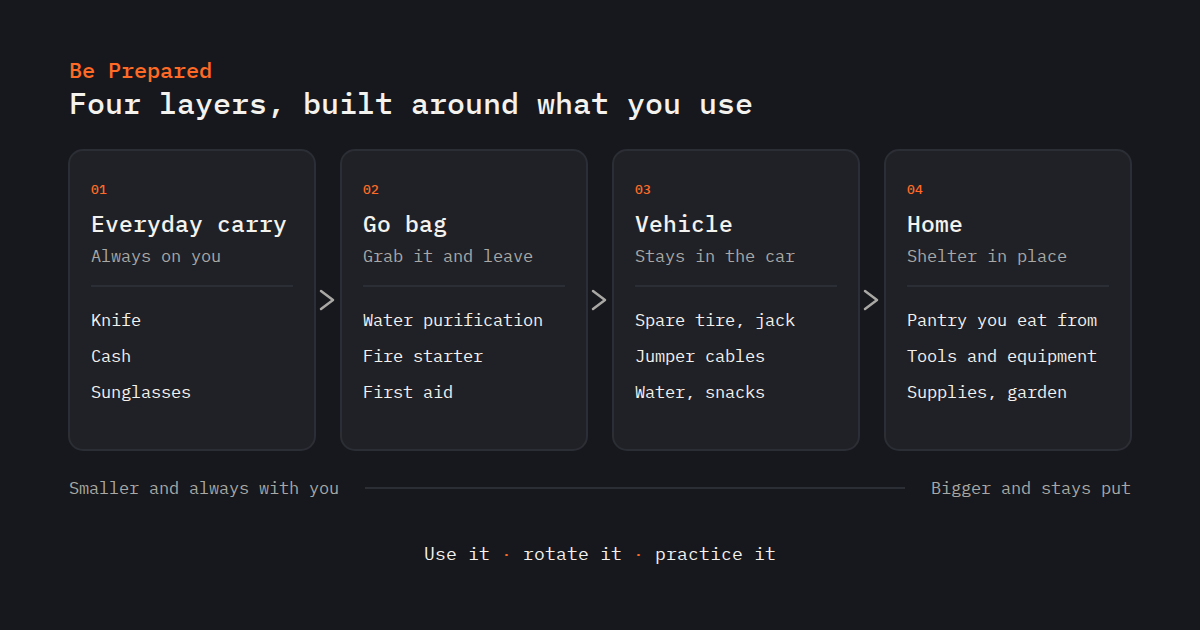
A power outage, an evacuation, and a camping trip call for different supplies, but much of the useful equipment overlaps. This guide brings together options for everyday carry, a go bag, your vehicle, and your home, with the reasoning behind each item. Start with the situations you are most likely to face, then build a kit you can carry, maintain, and use.
⚠️ Disclaimer: Every situation is different. The following are what I think may be important in a variety of situations. I’ve provided my rationale for every item but I am by no means an expert. Do your own research and only buy what makes sense for you. Some items in this list may not be legal for you to own. Consult your healthcare professional regarding first aid and medical recommendations. Do not take medical advice from someone on the internet.
Build around what you use
Start with equipment you know how to use and food you already enjoy eating. Whenever practical, choose supplies that also fit everyday life, camping, or an ordinary power outage. Use them, learn their limitations, and practice the skills that go with them before an emergency makes them necessary.
For your home pantry, stock what you eat and eat what you stock. Rotate older supplies into regular meals and replace them as you go. I keep rice and wheat berries on hand because we use them, rather than treating them as an untouched emergency stash. Familiar food is easier to plan and prepare, and regular rotation helps avoid forgotten supplies reaching the end of their usable life.
Dedicated emergency rations can still have a place, especially in a go bag where portability and long storage matter. They supplement this approach rather than replacing a pantry you use. Follow the product’s storage instructions and shelf-life guidance, and check those supplies periodically even if you don’t use them routinely.
Preparedness is also a set of habits: cooking with your supplies, using your tools, maintaining your equipment, and learning to handle more tasks yourself. This list is a menu of options to adapt to your situation, not a requirement to buy everything on it.
Affiliate links: Links to Amazon are affiliate links. As an Amazon Associate I earn from qualifying purchases, at no extra cost to you.
About these picks: Most items on this list are things I use or have tested. Some linked products are alternatives to equipment I own, including replacements for items that are no longer available. A recommendation does not mean I have personally tested that exact product.
Build your own preparedness list: Open the companion preparedness checklist in Google Sheets, then choose File → Make a copy to customize it in your own Google account. Choose the tabs that fit your situation, add or remove items, set your own quantities, and track what you have and what still needs attention. The shared template is read-only; your copy is yours to edit and share. This is a starting point, not a list of everything everyone needs.
Plan before you pack
Choose the situations you want to prepare for and how long you may need to manage without your usual services. Plan for both staying home and leaving. When your home remains safe, staying put—sometimes called “bugging in”—can keep you close to familiar surroundings, stored supplies, tools, and people you know. Leaving introduces its own uncertainties, so evacuation should be a response to the situation, not an automatic first step.
For staying home, plan for drinking water, food, sanitation, temperature control, and essential medical needs if utilities are interrupted. Know where to shelter for the hazards in your area; the safest place may be a particular room or another nearby building. For evacuation, decide where you would go, how you would get there, and what would make staying unsafe. Follow local shelter-in-place or evacuation instructions, and reassess as conditions change. FEMA’s preparedness guide covers planning for both options.
Account for prescriptions, medical equipment and its power needs, accessibility, children, and pets in either plan. Decide how your household would reconnect if phones were unavailable. Keep drinking water ready at home and pack a supply if you leave, rather than assuming you can find and treat it along the way. Match any carried load to the person carrying it; walk with your packed bag before relying on it. The Red Cross supply checklist is a useful planning reference to adapt to your household and climate.
The “Essentials” sections are starting points to consider, not a universal packing list. Select the optional tools for a specific need and the skills you have.
Everyday Carry (EDC)
Essentials
- Knife — I use mine multiple times a day, from opening packages to cutting rope or wires. A knife is also useful for trimming cordage, cutting tape or zip ties, and cutting material for small repairs. Find one that is comfortable to carry and use, and know how to clean and sharpen it.
- Sunglasses — Choose lenses with UV protection for time outdoors. Use impact-rated safety glasses or goggles for work that can throw dust or debris; ordinary sunglasses are not a substitute.
- Cash — Small bills may help when electronic payments are unavailable, provided shops are open and have supplies.
Optional Additions
- Pistol — Choose a common caliber (e.g. 9mm). Something like .50 AE or .30 Super Carry are often hard to find especially in an emergency. Whatever you choose to carry: know how to use it and maintain it. Don’t bother carrying if you aren’t training. Not being able to handle it properly will make it a liability not a resource.
- Flashlight — A small, portable flashlight can be essential for seeing in the dark or signaling for help.
- Whistle — Useful for signaling and attracting attention in an emergency.
- First Aid Kit — A compact first aid kit for treating minor injuries.
- Portable Charger — Keep your phone and other small devices charged.
- Pepper Spray — A less-lethal self-defense option. Learn how to carry and use it, check local restrictions, and follow the product’s expiration and storage guidance.
Bug out / Bail out / Go Bag
Essentials
- Bag — Consider what you need to carry, ease of access, and need for weather protection. Lots of compartments and zippers can make finding things difficult if you are not using the bag all the time.
- Multitool — Carry as little as possible by consolidating tools. Pick a good multitool that covers most use cases.
- Drinking Water — Pack safe drinking water and plan where you can replenish it. Containers and treatment equipment are useful backups, but they do not replace a ready supply.
- Water Treatment — Match the method to the water source and the contaminants it can address. Many portable filters do not remove viruses. Follow local advisories; fuel- or toxic-chemical-contaminated water needs a different safe source, not ordinary boiling, disinfecting, or filtering. See the CDC’s emergency water-treatment guidance.
- Water Disinfection Tablets — Compact and easy to carry. Follow the label for the amount of water, contact time, and water conditions; treatment effectiveness varies by product and organism.
- Personal Water Filters — Useful for individual drinking. Check the exact model’s contaminant-removal claims, maintenance instructions, and rated service life. Some designs let you drink directly but are less convenient for filling other containers.
- Pump Water Filters or Purifiers — Can help fill containers for a group. Check what the specific model removes, how it is cleaned, and whether replacement parts are available.
- Boiling — An option for killing germs when you have a suitable container and fuel. Follow the CDC’s boiling instructions, including the adjustment for elevation.
- Fire Starter — I like to have multiple options. No matter what you carry, be sure you are comfortable using it.
- Ferro Rod — A reusable source of sparks. Practice with suitable tinder in safe conditions before relying on it.
- Storm Proof Matches — Convenient when lighting a fire is difficult. Keep them dry and carry enough for your planned use.
- Magnifying Glass — No limit to the number of fires you can start and handy for reading a map but requires ideal sun exposure to work.
- Fire Rope — Convenient but not necessary. Pocket lint also works well.
- Mylar Thermal Blankets — A compact emergency layer against wind and heat loss. They add little insulation and do not replace warm clothing, ground insulation, or a sleeping bag suited to the temperature.
- Water Bottle — Lightweight and can be used to store items if needed. If space is a concern, the bottle can be clipped onto the bag. The bottle can be eliminated if the backpack has a built-in hydration pack or substituted for a Camelbak.
- Headlamp — A flashlight works too but it is nice to have both hands-free.
- Paracord — Lots of uses. Especially useful for shelters, tying things down, hoisting supplies into a tree, etc.
- First Aid — Build around your household’s needs and your training. Take a first-aid/CPR course and Stop the Bleed training for severe bleeding. In a serious emergency, make sure the scene is safe and call emergency services; equipment does not replace medical care.
-
First Aid Kit — Start with supplies for common injuries and learn how to use them. Check the contents and replace used or expired items. Keep trauma shears if your kit includes bleeding-control equipment; small multitool scissors may not serve the same purpose.
-
Routine Prescriptions and Medical Supplies — Plan an emergency supply with your prescriber or pharmacist, including any temperature-sensitive storage needs. Keep a current medication list and the supplies needed to use prescribed devices.
-
Medications — Buy travel packs to save space. Follow each medication’s labeled expiration date and storage instructions, and replace supplies before they expire. Ask a pharmacist about medication-specific storage and replacement timing. Consider pain medications, antibiotics (requires prescription), allergy medications, sinus decongestants, cough suppressants, and gastrointestinal medications. A pill organizer may be a better option in some cases.
Some medications have shown stability beyond their labeled expiration dates in published research and stockpile studies. The FDA’s Shelf-Life Extension Program applies to selected federal stockpiles and uses periodic stability testing. These findings do not establish that medicines stored at home remain safe or effective after expiration.
-
Hemostatic Gauze — For controlling severe bleeding in wounds suitable for packing. Learn appropriate use in bleeding-control training; do not pack an open chest wound.
-
Tourniquet — For life-threatening bleeding from an arm or leg. Learn to recognize that bleeding and apply the device in hands-on training.
-
Chest Wound Supplies — An open chest wound needs immediate emergency care. Call 911 and follow emergency medical instructions when they are available. Red Cross guidance allows leaving it open to air, using a clean dressing that does not seal it airtight, or using a specialized vented chest seal. If you are trained to use one, or a trained responder is available, keeping a vented chest seal in the kit makes that option available. If a dressing is applied, watch for worsening breathing and loosen or remove it if needed. Do not improvise an airtight seal with plastic sheeting.
-
Disposable Gloves — Wear them when contact with blood or body fluids is possible, regardless of whether you know the person’s medical history. Choose a suitable fit and replace damaged gloves.
-
Potassium Iodide (KI) — A situation-specific medicine that protects the thyroid from radioactive iodine, not from radiation generally. Take it only when public-health officials or a healthcare professional directs you to. Follow CDC guidance on who should take it and when. Ask a pharmacist about an age-appropriate formulation and dose; the FDA also provides instructions for preparing liquid KI from tablets.
-
- Extra Batteries — For your flashlight, radio, and other battery-operated devices.
- Maps — Internet may be down and even if you have a local copy downloaded on your phone, your phone may not work. Consider having a local map with lots of details and more broad map of the entire country’s interstate highways.
- Compass — Needed for accurate navigation but you should be able to roughly navigate based on the Sun and Stars.
- Nested steel cooking set — Great for cooking or heating water. Do not buy double wall steel for this purpose.
- News and Weather Radio — A battery-powered receiver can provide information when internet service is unavailable. In the U.S., choose one that receives local broadcasts and NOAA Weather Radio; ordinary AM/FM reception does not include NOAA’s weather band. Receiving these broadcasts does not require a GMRS or amateur license. Set it up and test reception before an emergency. See NOAA’s receiver guidance.
- Cleaning Wipes — Good for cleaning hands or a sponge bath if water is scarce.
- Hygiene and Sanitation Supplies — Pack soap, toilet paper, menstrual supplies, and waste bags as needed. Include diapers or other personal-care supplies your household uses, and plan for a toilet or safe waste disposal at your destination.
- Duct Tape — Don’t waste space by carrying a whole roll. Either make your own small roll or buy a pre-made small roll.
- Gloves — You will likely be using your hands a lot. Get a good pair of leather gloves that will last.
- Particulate Respirator — A well-fitting, NIOSH-approved N95 can reduce exposure to wildfire-smoke particles. Bandanas are not a substitute, and particulate respirators do not protect against gases such as carbon monoxide. See NIOSH’s guidance on respirators and masks.
- Emergency Rations (Food) — These will give you energy to keep moving but are not a good long term supply of nutrients. Once you get where you are going, you will need to find other sources of food.
- Clear Plastic Drop Cloth — Lightweight material for a temporary rain cover, shelter, or rainwater collection. It tears easily; collected water still needs appropriate treatment before drinking.
- Notepad, Tactical Pen, and Pencil — For emergency information, notes, directions, etc. A tactical pen doubles as a less lethal self defense tool and a window punch.
- In Case of Emergency (ICE) card — This could be a page in a notebook but it should be easy to find. Include details for each member of family and make sure everyone knows where to find this information.
- List of medications
- List of known medical history and concerns (e.g. Hypertension, Diabetes)
- Emergency contacts
- Blood type
- Important Information — Could be in a notebook or stored with map.
- Local emergency radio frequencies
- Addresses and GPS coordinates for important destinations
- Copy of Drivers License
- Copy of Passport
- Copy of Insurance
- Photo of each family member — This is helpful when searching for someone in a disaster situation.
Optional Additions
Choose these additions for a specific use, climate, or destination. Each one adds weight and takes space, so try your packed bag before deciding what stays.
General
- Pack Organizer — Makes finding things a little easier.
- Water-resistant Zipper Pouch — Better quality than ziplock bags.
- Electrolyte Pouches — A portable drink option. Follow the label’s intended use and mixing directions; an unspecified electrolyte drink should not be treated as a remedy for illness.
- Sunscreen — Include sun protection for time outdoors, along with suitable clothing and shade. Follow the label for application and reapplication.
- Silver and/or Gold coins/bullion — If cash isn’t worth anything, and you don’t have anything to barter with, precious metal may still be worth something.
- Hand Warmers — Useful for keeping hands warm in cold weather. They’re single-use and need no charging; check the date on the package.
- Collapsible Shovel — Useful for digging and various other tasks. A sturdy steel one weighs about 2 lb, so weigh it against the rest of your bag.
- Sleeping Bag and Ground Insulation — Choose a sleeping system for the expected overnight conditions. A thin emergency bivy or Mylar blanket can help block wind but is not equivalent to an insulated sleeping bag and sleeping pad.
- Two-Way Radio — Useful when the people you need to reach have compatible equipment and are within range. In the U.S., GMRS and amateur radio have different licensing and equipment requirements. A GMRS license does not make an arbitrary handheld suitable for GMRS; use equipment certified for that service. Agree on channels or frequencies and practice before an emergency.
Urban
- Solar Battery — Great for charging small devices like phones and flashlights. All of which should be considered conveniences and not something needed to survive.
- Satellite Communications — A satellite phone or messenger may help when local phone networks fail, including during a widespread disaster. Voice calls, messaging, and SOS features vary by device. Plan for the service subscription, charging, and a clear view of the sky, and test it before relying on it. A working device cannot guarantee that help can reach you. Iridium describes examples of satellite use during major disasters.
- Navigation with GPS — Helpful for locating yourself and following a route. Carry appropriate maps and practice navigating without an electronic device.
- Sillcock Key — Opens water valve on commercial buildings.
- OEM Penetration Keys — Open elevators, garage doors, cabinets, vehicle glove boxes, etc.
- Heavy Equipment Keys — For operating tractors, construction equipment, etc.
- Door Latch Bypass — Useful for quick entry when the door latch is exposed like with pool gates and interior doors.
- Lockpick — Don’t bother with a large kit if you aren’t already a skilled locksmith. Get either a pocketknife style set or a small set. You shouldn’t need more than a half dozen picks to open most locks. Get a transparent training lock and practice. There is no point in carrying something you do not know how to use.
- Crowbar — Useful for prying open doors or windows in an emergency.
- Light Sticks — Provide light without using batteries, useful for marking locations or signaling.
Wilderness
- Emergency Tent — Mylar blanket and paracord could be used instead but this is quick and easily reusable.
- Campfire Tripod Plate — Makes cooking over an open fire easier.
- Hand Auger — Useful for making shelters and branch tripods for cooking over a fire.
- Pocket Saw — Great alternative to carrying an axe or hatchet. Can be used for acquiring wood for a fire or shelter.
- Flat Pack Stove — Great for cooking or heating water. Alternatively you can cook directly on hot coals.
- Insect Repellent Wipes — With wipes there isn’t a concern with spills and leaks. These are individually wrapped.
- Fishing Kit — Basic fishing supplies for catching food.
- Signal Mirror — For signaling aircraft or distant search teams.
- Snare Wire — For trapping small game.
Vehicle
Essentials
- Spare Tire — A properly inflated spare tire is crucial for any road trip. Make sure it’s in good condition and ready to use.
- Jack and Lug Wrench — Essential tools for changing a tire. Ensure you know how to use them.
- Jumper Cables — Useful for jump-starting a dead battery. Consider a portable jump starter for added convenience, sized for your engine.
- Tire Pressure Gauge — Regularly check tire pressure to prevent blowouts and maintain fuel efficiency. An analog gauge needs no batteries.
- First Aid Kit — Basic medical supplies to handle minor injuries on the road.
- Reflective Warning Triangles or Flares — To warn other drivers if you are stopped on the side of the road.
- Flashlight — A reliable, battery-powered flashlight for night-time emergencies.
- Multitool — Choose tools that fit the minor repairs you know how to make.
- Blanket — Warmth in case you get stranded in cold weather.
- Water and Non-Perishable Snacks — Stay hydrated and maintain energy levels if you are stuck for a prolonged period.
- Fire Extinguisher — Small, automotive-specific extinguisher for dealing with small fires.
- Vehicle Manual — The vehicle’s manual can provide troubleshooting tips for common problems.
- Gloves — Protect your hands while working on your vehicle.
- Zip Ties — Useful for securing loose items or making quick, temporary repairs.
Nice to Have Items
- Portable Air Compressor — To inflate tires if they become under-inflated. Check that it covers your tire size and pressure.
- Tire Repair Kit — For minor tire repairs if a spare tire is not available.
- Tow Strap or Rope — Useful if you need to be towed or help someone else.
- Duct Tape — For temporary repairs on hoses or other vehicle parts.
- Bungee Cords — Useful for securing items or keeping things in place.
- Window Breaker and Seatbelt Cutter — In case of an emergency where you need to escape the vehicle quickly. Spring-loaded breakers work on tempered side windows, not laminated glass; check which your car has, and keep it within reach.
- Phone Charger — Keep a car charger for your phone to ensure you can call for help.
- Portable Battery Pack — Additional power source for your electronic devices. Be careful leaving batteries in the car in hotter climates as they could be damaged and possibly explode.
- Rain Poncho — To stay dry if you need to work outside the vehicle in the rain.
- Maps — Physical maps of your usual routes and surrounding areas in case GPS is unavailable.
Seasonal Considerations
- Winter Gear — Extra blankets, warm clothing, hand warmers, ice scraper, snow shovel, and sand or kitty litter for traction on ice.
- Summer Gear — Extra water, sunscreen, and a wide-brimmed hat for protection against the sun.
Home
This section aims to provide a list of items to be kept around the home not just for disasters but for everyday use.
Pantry
Build meals from food your household already eats. Dried staples need water, fuel, and cooking time, so include familiar foods you can eat without cooking. Keep a manual can opener with canned food that needs one.
Storage life depends on the product, packaging, temperature, and whether it has been opened. Follow label instructions, including refrigeration after opening, and rotate food into everyday meals. For home-preserved foods, use tested preservation methods and their storage guidance.
Dry Goods
- Beans (Pinto, Kidney, and Black) — Protein and fiber for familiar meals; plan for soaking and cooking as appropriate.
- Rice — A staple for meals; keep enough water and a workable cooking method.
- Cocoa — For baking or a familiar hot drink.
- Sugar — For sweetening and baking.
- Salt — For seasoning; follow a tested recipe when using it in food preservation.
- Lentils — A dry staple for soups and other meals.
- Powdered Milk — Useful in drinks, cooking, and baking when prepared as directed.
- Bouillon (Beef and Chicken) — Adds flavor to soups, rice, and other staples.
- Electrolyte Powder — Follow the label’s intended use and mixing directions. It is not a substitute for safe drinking water or medical care when needed.
- Food or Meal Powders — Check the actual nutrition label and preparation instructions; products vary and are not necessarily complete meals.
- Wheat Berries — For cooking whole or milling into flour if you have the equipment.
- Dried Fruit — A ready-to-eat snack or addition to meals.
- Jerky — A ready-to-eat protein option; follow its storage instructions.
- Pasta — Familiar meals when water and a cooking heat source are available.
- Powdered Eggs — For recipes suited to the product; follow its preparation and storage instructions.
Fats
- Olive Oil — For dressings and cooking.
- Coconut Oil — For recipes your household already makes.
- Ghee — Clarified butter for cooking; follow the product’s storage instructions.
- Tallow — Rendered beef fat for cooking.
Cans and Jars
- Tomatoes — A base for soups, sauces, and other meals.
- Beans — A cooked alternative when time, water, or fuel is limited.
- Tuna — A convenient protein option.
- Sardines — A protein option that also provides omega-3 fats.
- Salmon — Another canned fish option for familiar meals.
- Lentils — A cooked alternative to dry lentils.
- Chicken Soup — A familiar meal; check whether the product needs added water.
- Chili — A prepared meal; check the label’s heating and storage directions.
- Chicken — For sandwiches, soups, and other meals.
- Peanut Butter — For snacks and sandwiches, if suitable for your household’s allergies.
- Mixed Vegetables — An easy addition to meals.
- Mixed Fruit — A ready-to-eat option for variety.
Baking Supplies
- Baking Powder — A leavening ingredient; check its date and replace it as needed.
- Baking Soda — For baking and suitable household cleaning tasks.
- Cornstarch — For thickening sauces and soups.
- Vanilla Extract — For familiar baking recipes.
Whole Spices
- Peppercorns — For seasoning; keep a way to grind them.
- Cinnamon Sticks — For flavoring food and drinks.
- Cumin — For seasoning meals.
Other
- Apple Cider Vinegar — For dressings and other recipes.
- Soy Sauce — For seasoning; follow storage directions after opening.
- Real Maple Syrup — A sweetener; follow storage directions after opening.
- Honey — For sweetening food and drinks.
- Vinegar — For cooking and suitable cleaning tasks. For food preservation, use the type and acidity specified by a tested recipe.
Comforts
If you have room after covering the essentials, consider a few familiar comforts such as coffee, chocolate, or a small amount of liquor for adults who choose to drink. Small treats and familiar routines can make a difficult situation more tolerable. These items may also have barter value, depending on the circumstances. Liquor should not be relied on for sterilization or medical disinfection.
Tools and Equipment
- Grain Mill — A way to turn wheat berries into flour. The NutriMill is an electric option; a manual mill can work when power is unavailable. Practice milling and baking with your setup so you know the time and effort involved.
- Axe — Useful for chopping wood, building shelter, and other heavy-duty tasks.
- Hatchet — Smaller than an axe, useful for lighter chopping tasks.
- Propane Stove — An outdoor cooking option during an outage. Use camping stoves outside, away from doors, windows, and vents, and follow the manufacturer’s clearance and fuel instructions. Never use one to heat your home.
- Dual Fuel Generator — Backup power from gasoline or propane. Operate it outdoors, more than 20 feet from the home, doors, and windows, with exhaust directed away. Never run it in a garage, even with the door open. Follow CDC power-outage safety guidance and the manufacturer’s electrical-connection instructions.
- Wood Stove or Fireplace — Heating and cooking option if electricity is unavailable.
- Propane Adapters — Allows for the use of various propane-powered devices.
- Stored Drinking Water — Keep safe water ready for drinking and food preparation. Use Red Cross planning guidance to size the supply for your household, conditions, and expected outage.
- Portable Drinking-Water Containers — Choose food-grade containers intended for drinking water. Size them so you can move them when full, and follow cleaning and storage instructions.
- Water Storage Tanks — For larger reserves, use a tank intended for potable water and plan how to fill, maintain, and dispense it if power is unavailable.
- Heavy Duty Tarp — Versatile, can be used for shelter, covering supplies, or collecting water.
- Kerosene Heater — Consider one only if it is permitted locally and designed for the intended setting. Follow its fuel, ventilation, and clearance instructions; not every portable fuel-burning heater is suitable indoors. See CDC winter-storm heating guidance.
- Carbon Monoxide Alarms — Install battery-powered alarms or alarms with battery backup, and test them as directed. They complement safe equipment use; they do not make indoor generator or camping-stove use safe.
- Lantern — Provides light, useful for nighttime activities.
- Flashlight — Essential for visibility in the dark.
- Rifle — For hunting and self-defense.
- Shotgun — Versatile for hunting and self-defense.
- Gas Masks and Respirator Cartridges — Protection depends on the specific hazard, cartridge, fit, and equipment limitations. A generic mask does not protect against every gas or provide oxygen. Do not rely on one to enter a fire or an unknown atmosphere. See NIOSH’s explanation of respirator limitations.
- Submersible Water Pump (Subpump) — Useful for removing water from flooded areas.
- Emergency Fire Blanket — Can extinguish small fires, useful for personal protection.
- Manual Can Opener — Keep one with food in cans that require an opener.
- Pressure Cooker — Speeds up cooking. Choose one compatible with your cooking heat source.
- Canning Equipment — Useful for preserving food long-term. For meat and most vegetables, use a suitable pressure canner and tested USDA or NCHFP instructions, including altitude adjustments. An ordinary pressure cooker or electric multicooker is not a substitute. The linked canner doesn’t work on induction cooktops.
- Solar Charger — For recharging batteries and small devices using sunlight.
- Waterproof Bags — For keeping important items dry.
- Rope — Strong, durable rope for a variety of uses.
- Chainsaw — For cutting larger pieces of wood (requires maintenance and fuel).
- Tire Repair Kit — For patching flat tires on vehicles.
- Binoculars — For scouting and surveillance.
Supplies
- Ammo — Essential for hunting and self-defense.
- Tea Candles — An optional light source, not a space heater. Prefer battery-powered lights during an outage. If you use candles, keep them in stable holders away from combustible materials, children, and pets, and never leave them burning unattended. See CDC candle guidance.
- Fire Extinguisher — Essential for putting out small fires.
- Seeds — For growing food, essential for long-term self-sufficiency.
- Feed — For livestock if you have any.
- Fuel
- Propane — Versatile fuel source for cooking, heating, and generators.
- Kerosene — Used for heaters and lamps.
- Wood — Essential for heating and cooking if you have a wood stove or fireplace.
- Gasoline — Needed for generators and vehicles.
- Trash Bags — Multiple uses, including waste management and rain protection.
- Soap — For hygiene and cleaning.
- Bleach — Surface disinfection and emergency drinking-water treatment require different instructions. For water, use a suitable unscented product and follow CDC directions for its concentration and the water conditions; do not guess the dose.
- Gloves — Additional pairs for handling various materials or situations.
- Rubbing Alcohol — For disinfection and medical use.
- Zip Ties — Useful for securing items quickly and easily.
Garden
- Ginger — For flavoring meals and drinks where your growing conditions suit it.
- Potato — High yield, versatile, and easy to grow.
- Carrots — Nutritious and easy to store.
- Onions — Essential for cooking, long storage life.
- Garlic — For seasoning meals; choose varieties suited to your climate.
- Lettuce — Quick-growing, provides fresh greens.
- Spinach — Nutritious and easy to grow.
- Tomatoes — Versatile in cooking, high in vitamins.
- Herbs (e.g., basil, rosemary, thyme) — Grow the ones you use for seasoning meals.
- Beans — High yield and good source of protein.
- Peas — Easy to grow and nutritious.
- Corn — Versatile and can be stored long-term.
- Squash — High yield and good storage potential.
- Berries — Nutrient-rich and good for fresh eating or preserving.
Winter at home: planning for 7–14 days without utilities
In the Austin area, an ice storm can leave a home without electricity while fallen branches and icy roads make travel difficult. Fuel pumps, shops, and deliveries may also be unavailable. If your home remains safe, plan to manage with the supplies already there instead of assuming you can leave or restock after the storm begins.
Use 7–14 days as a planning example for an extended outage, then adapt it to your household, storage space, and needs. Fourteen days is a suggested margin for an outage lasting more than a week, not an official Austin requirement or a guarantee that every emergency will be over by then. Build on the home supplies above and decide how you will use them when electricity, running water, or both are unavailable.
Heat and fuel that work together
- Check what works without electricity. An oil-filled electric radiator still needs power. A fuel-burning heater may also need electricity for its controls, pump, or fan. Check the manual and test the approved outage setup before relying on it. A wood stove and an open fireplace also differ in how effectively they heat a room; do not assume either will keep the whole house warm.
- Measure fuel in days of use. Record how much fuel your setup uses during cold weather, then estimate the supply for your planned outage and add a reserve for colder conditions or a longer interruption. A mild-weather test may underestimate demand. Include cooking fuel in the calculation. Buy and store fuel ahead of time using approved containers and the appliance’s specified fuel; follow local storage requirements. Do not depend on a trip to the gas station during the outage.
- Prepare the wood supply. Keep seasoned firewood dry and accessible, with kindling, lighters or matches, stove gloves, and a covered metal ash container. Store ashes outside away from the house and combustible materials. Freshly fallen branches are not a dependable supply of dry firewood. The EPA’s wood-burning guidance recommends wood below 20% moisture.
- Service the stove and chimney. Arrange an annual chimney or flue inspection and any needed cleaning before winter. Follow the stove’s loading, clearance, and operation instructions; do not overfire it to compensate for a cold house. The CDC’s winter preparation guidance covers chimney inspection and alarm preparation.
A warm room and a warm sleeping setup
Choose a room where the household can gather, and reduce drafts with weatherstripping, window coverings, and closed doors to unused rooms where appropriate. Keep required combustion-air openings, appliance ventilation, and exits clear. Use an indoor thermometer to track conditions. A warm room does not protect pipes in the rest of the house.
Keep warm bedding or insulated sleeping bags for each person, insulating pads if anyone will sleep on the floor, thermal layers, hats, socks, and dry spare clothing. Thin Mylar blankets can supplement this setup but do not replace insulation. Plan sleeping arrangements that remain usable when a fire burns down, with bedding safely clear of heating equipment. Never leave a portable fuel-burning heater operating while you sleep; follow its instructions for attended use. See the CPSC’s winter heater guidance.
Test smoke and carbon-monoxide alarms, including their battery backup, before the season. Keep a suitable fire extinguisher accessible. Alarms do not make unsafe heater use safe. Never heat a home with a camping stove, grill, or cooking oven, and do not count candles as a heating source. Follow the CDC’s winter-storm heating guidance.
Protect pipes before the house gets cold
- Find the water shutoff. Locate and label the property owner’s valve, keep it accessible, and know which tool operates or accesses it. Renters should get instructions from the property manager. Have a plumber address a stuck or damaged valve before an emergency.
- Prepare exposed plumbing. Disconnect garden hoses, cover outdoor faucets, insulate vulnerable pipes, and winterize irrigation. Check the manufacturer’s freeze-protection instructions for water heaters. Electric heat tape and powered freeze protection stop working when their electricity is unavailable.
- Make a plan for a prolonged loss of heat. Ask a plumber how to shut off and, where appropriate, drain your particular system, including what to do with its water heater and appliances. Closing a supply valve does not empty all the pipes. Do not improvise a whole-house draining procedure during a freeze.
- Follow your water provider’s current instructions. Dripping guidance can change during an extended freeze or a water-system emergency. Austin Water’s cold-weather page explains local preparation and shutoff guidance. If you use another provider, follow its notices. Never use an open flame to thaw a pipe.
Stored water and sanitation
Austin Water recommends at least one gallon of water per person per day for seven days. Using that baseline, two people planning for 14 days would store 28 gallons. Add water for pets and any needs beyond the baseline, including extra washing and flushing. Keep drinking water in food-grade containers where it will remain accessible and protected from freezing.
Store utility water separately and label it if it is not safe to drink. Include a portable toilet or emergency toilet bags, toilet paper, soap, and the personal-care supplies your household needs. Plan safe waste storage and follow local disposal instructions. Use stored water for flushing only while the sewer or septic system is functioning and local guidance permits it.
Keep safe drinking water available even if you own a filter. During a boil-water notice, follow the water provider’s instructions; an ordinary pitcher filter is not a substitute for the required treatment. Include any water-treatment fuel in your cooking budget. See Austin Water’s emergency information.
Meals and cold food during an outage
Count complete days of meals for everyone, using familiar food and the water and fuel actually available. Keep a manual can opener with canned food. Include meals that need no cooking in case going outside to cook is unsafe. Dry beans, rice, and wheat berries are useful only when you also have the equipment, water, and cooking time they require.
Use a wood stove for cooking only if its manufacturer allows it and you have suitable cookware. Keep camping stoves outdoors and follow their instructions. Plan for leftovers too; normal refrigeration may be unavailable.
Keep thermometers in the refrigerator and freezer. With doors closed, a refrigerator generally keeps food safe for about four hours; a full freezer holds its temperature for about 48 hours, or 24 hours if half full. Save the FoodSafety.gov outage guide before the storm. Do not rely on smell or taste to decide whether food is safe, or assume the temperature outdoors will keep it safely refrigerated.
Power for the things that need it
List the devices you need, their power use, and how many hours a day they must run. Include phones, lights, medical equipment, and any heating controls or fans. Size batteries using watt-hours and allow for conversion losses; the inverter must also support the appliance’s running and startup power.
For perspective, a 1,500-watt electric heater would use a nominal 1,000-watt-hour battery in 40 minutes even before losses. Small battery stations are usually more practical for modest electrical loads than for heating a room. Test your actual setup and follow battery temperature limits for charging and use. Do not assume solar panels will replenish everything during cloudy or icy weather.
If using a generator, plan its fuel supply and a safe outdoor operating location before the storm. Follow the generator guidance in Tools and Equipment and the manufacturer’s weather-protection instructions. Never operate it indoors or in a garage, and never connect it to house wiring through a wall outlet.
Access, communication, and household needs
- Keep essential supplies reachable. Have suitable footwear, boot traction aids, and grit or an appropriate ice-melt product for the route to your fuel and supplies. Avoid walking beneath ice-loaded branches. Arrange tree maintenance before winter; contact the utility about branches near power lines. Stay away from downed lines and anything touching them, and report them.
- Plan for people and pets. Arrange medication reserves and any temperature-sensitive storage or medical-device backup with the appropriate clinician, pharmacist, or supplier. Include pet food, water, medications, and a warm indoor place. Account for anyone who needs help moving, staying warm, or communicating.
- Agree on check-ins. Exchange contact details with nearby people you trust and decide how to check on one another if phone or internet service fails. Keep printed contacts, charged phone batteries, and a tested news/weather radio. Save your utility’s outage-reporting details and Austin’s emergency alerts page. The city’s winter-readiness guidance covers household and medical planning.
- Decide when to request help. If anyone cannot stay warm, essential medical equipment is approaching the end of its backup supply, or the home becomes unsafe, seek help before the situation worsens. Plan how to request assistance even when self-evacuation is not possible. For fire, a carbon-monoxide alarm, or another immediate danger, move to safety and call 911.
Before winter, try the routine during safe conditions: prepare a meal with the planned equipment, check lighting and charging, find the water shutoff, and measure fuel use. Record what runs out or does not work, then fix those gaps before a storm makes them urgent.
Skills and Training
Practice regularly so you can use your skills when conditions are difficult. Start in controlled conditions, learn from qualified instructors, and build experience before relying on a skill in an emergency.
For an introduction, I like Jessie Krebs’s Wilderness Survival MasterClass. Krebs is a former U.S. Air Force SERE (Survival, Evasion, Resistance, and Escape) instructor. Her class introduces survival mindset, signaling, navigation, water, shelter, and fire. It is a paid online introduction to wilderness survival; follow it with hands-on instruction and practice suited to your environment.
- Starting Fire — Essential for warmth, cooking, and signaling.
- Shelter Building — Crucial for protection from the elements.
- Canning — Preserves food for long-term storage.
- Gardening — Provides a sustainable food source.
- Sourdough Bread Making — Allows for homemade bread without commercial yeast.
- Navigation — Essential for finding your way without modern technology.
- Hunting and Gathering — Provides food in the wild.
- First Aid (CPR and Trauma) — Essential for treating injuries and saving lives.
- Water Harvesting — Techniques for collecting and purifying water.
- Basic Cooking — Knowledge of how to prepare simple, nutritious meals with limited resources.
- Knot Tying — Essential for securing shelters, tying down equipment, and more.
- Fishing and Trapping — Additional methods for sourcing food in the wild.
- Tool Maintenance — Keeping your tools in good working condition.
- Self-Defense — Basic skills to protect yourself in dangerous situations.
Next steps
Choose one situation and make a list for your household. Check what you already have, fill the most important gap, and practice with the supplies you plan to rely on. Test the weight of your go bag and the setup for an ordinary outage. Set a reminder to review food, medications, batteries, and seasonal needs.
References and Additional Resources
- FEMA (Federal Emergency Management Agency)
- Ready.gov — Comprehensive resource for emergency preparedness information, including checklists, tips, and plans for various disasters.
- FEMA Emergency Supply List — A detailed checklist of emergency supplies recommended by FEMA.
- CDC (Centers for Disease Control and Prevention)
- Emergency Preparedness and Response — Information on preparing for various types of emergencies, including natural disasters, bioterrorism, and pandemics.
- Natural Disasters and Severe Weather — Guidelines and recommendations for staying safe during and after natural disasters.
- American Red Cross
- Disaster Preparedness — Tips and resources for preparing for different types of disasters, creating emergency kits, and making evacuation plans.
- Emergency Preparedness Checklist — Printable checklist for emergency supplies and plans.
- Department of Homeland Security (DHS)
- Disaster Planning — Resources and information on disaster preparedness, response, and recovery.
- Cybersecurity and Infrastructure Security Agency (CISA): Emergency Communications — Information on maintaining communication during emergencies.
- National Oceanic and Atmospheric Administration (NOAA)
- NOAA Weather-Ready Nation — Resources for preparing for extreme weather events and understanding weather alerts.
- National Hurricane Center — Detailed information on hurricane preparedness and tracking.
- U.S. Geological Survey (USGS)
- USGS Earthquake Hazards Program (Preparedness) — Information on earthquake preparedness, hazard maps, and real-time earthquake data.
- USGS Volcano Hazards Program (Plan and Kit) — Resources on volcano preparedness and monitoring.
- USGS Earthquake Recommendations — Emergency supplies needed for an earthquake.
- National Fire Protection Association (NFPA)
- Emergency Preparedness — Guidelines for fire safety and emergency planning.
- Humane World for Animals (formerly The Humane Society of the United States)
- Disaster Preparedness for Pets — Tips for including pets in your emergency plans.
Revisions
- October 5, 2026 — Added an Austin-area winter-at-home planning section covering extended utility outages, heating and fuel, warm sleeping arrangements, pipe protection, stored water and sanitation, food, essential power, and household support.
- October 5, 2026 — Corrected guidance on first aid, water treatment, respiratory protection, heating, and emergency communications. Added household planning and storage guidance, clarified equipment limitations, revised pantry descriptions, and added an introductory wilderness-survival course recommendation.
- October 5, 2026 — Added selected equipment recommendations and product links to the preparedness checklist. Added a customizable Google Sheets companion checklist with scenario tabs, purchase links, and buying priorities. Added personal context connecting the title to my experience as an Eagle Scout. Restored a vented chest seal link and added a reminder to call 911.
- October 4, 2026 — Added guidance on familiar supplies, food rotation, everyday preparedness habits, and practical knife uses, and clarified that some product links are alternatives to equipment I have tested. Added practical next steps for readers. Added an overview diagram of the four layers.
- October 3, 2026 — Replaced the blanket medication rotation interval with labeled expiration and storage guidance, and clarified the limits of extended shelf-life research. Clarified the distinction between pressure cooking and safe pressure canning. Reframed optional comfort supplies around morale and potential barter value; removed the liquor sterilization and pain-relief claims. Earlier changes are not itemized.